
LAST NEWS
Rally WRC Stars at Ice Series 2016
Friday, 23, October, 2015
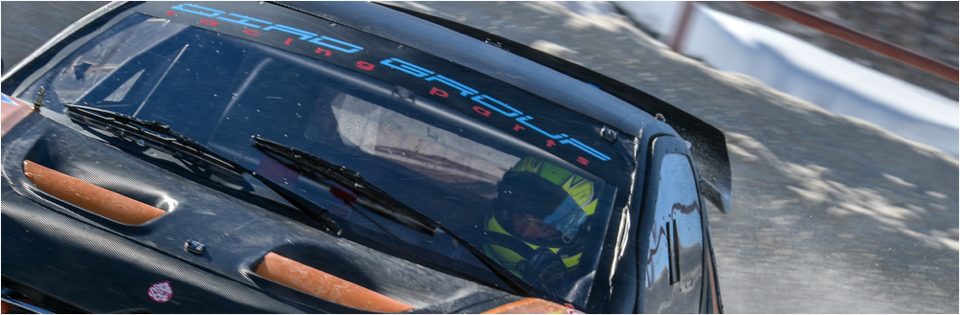
Everything is under frenetic preparation in D4S Motorsport factories for the next 2016 winter Ice Series International Championship. The incredible prototype based on the WRC Citroen DS3 is actually collecting all the latest racing technologies as nanotechnology surface engineering, additive manufacturing made D4S Motorsport titanium sequential gearbox, lithium batteries and Inconel exhausts, and a full composites body.
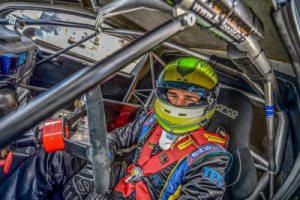
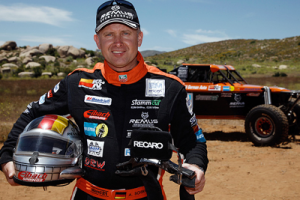
960 Kg, 450 HP, four wheel drive. Such an advanced technologies will be hardly tested by an exceptional famous driver, the WRC star Armin Schwarz that will share the driving wheel with the other D4S Motorsport top drivers in the most important races of the 2016 Championship.




Sustainable automotive technology
Friday, 23, October, 2015
The Life Cycle Engineering (LCE) is a methodology for the assessment of the environmental and economical impact of products, usually considering their whole life cycle: production, use phase and end of life. The analysis is conducted taking into account technical boundaries (technical feasibility).
The LCE is structured by Life Cycle Assessment (LCA) and Life Cycle Costing (LCC), devoted to the respectively of the environmental impact assessment and the economical impact assessment.
Even if for some people this will look quite strange, the Motorsport sector is one of the most advanced sector in the sustainability and environmental awareness. This is why the continue research of performance and efficiency in engineering terms means continuous looking for fuel consumption reduction and use of advanced and often precious and expensive materials that should be 100% recycled or reused at the end of life. A proof of that is the fact the winning cars in the Le Mans Series, probably the best bench for innovation, are the most advanced hybrid cars even conceived and made on the Earth. Same is the F1.
In D4S Motorsport we are deeply convinced about the strategic advantage we are giving to our products through specific sustainability methodologies and analysis. We have experience on sustainability analysis since 1995.
We would spend a couple of words concerning the capability to conduct a serious LC analysis. One of the key phase to carry out a correct LC analysis is the “interpretation of the results”, where the industrial experience and technical background of the engineers are still playing the main role. Without the correct sensitivity that only trained personnel from well established industries, that grew their experience in years of tests and experiments, success and failures, it is not possible to carry out a sustainability analysis in the most effective and serious way. So even if you have the best software available in the market, but you don’t know deeply the process you are analyzing, it is quite hard you will get serious results. It is exactly the same situation of having a state of the art FEM software and trying to design a racecar or an airplane without having ever done it before. The result will have high probability to be a disaster.
This is why we consider LCA and LCC analysis a serious matter and we are constantly improving our experiences and skills with a daily comparison between numerical and experimental results.
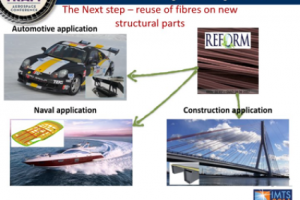
TRAM 2014 worldwide conference at IMTS Chicago
Wednesday, 10, September, 2014
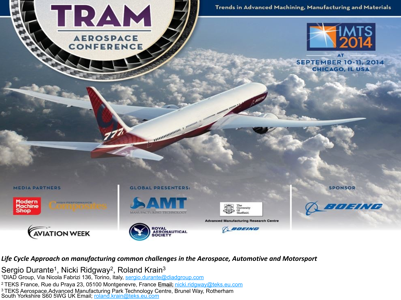
Dr. Nickolas Ridgway and Dr. Eng. Sergio Durante participated at the International Conference TRAM (Trend in Advanced Machining, Manufacturing and Materials) in Chicago at the IMTS 2014, the famous Machine Tool and Robotic fear in USA.
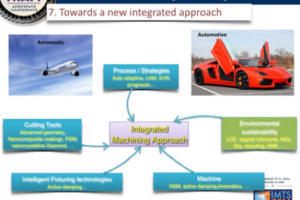
They presented a new approach on the manufacturing of high quality components for motorsport and aeronautic sector, based on a life cycle approach. This permits to achieve better, faster and less pollutant components with respect to the previous technologies.
Some of the technologies and results were developed and tested in the European Funded Project REFORM, dealing with advanced composites materials.